Publications & Preprints
KernelArc: A Multi-Agent Framework for GPU Kernel Optimization
- Authors: Joyjit Kundu, Ben Stoffelen, Kaili Wang, Peter Vrancx, Ludovic Denoyer
- Release Date: August 17, 2026
- Where: arXiv
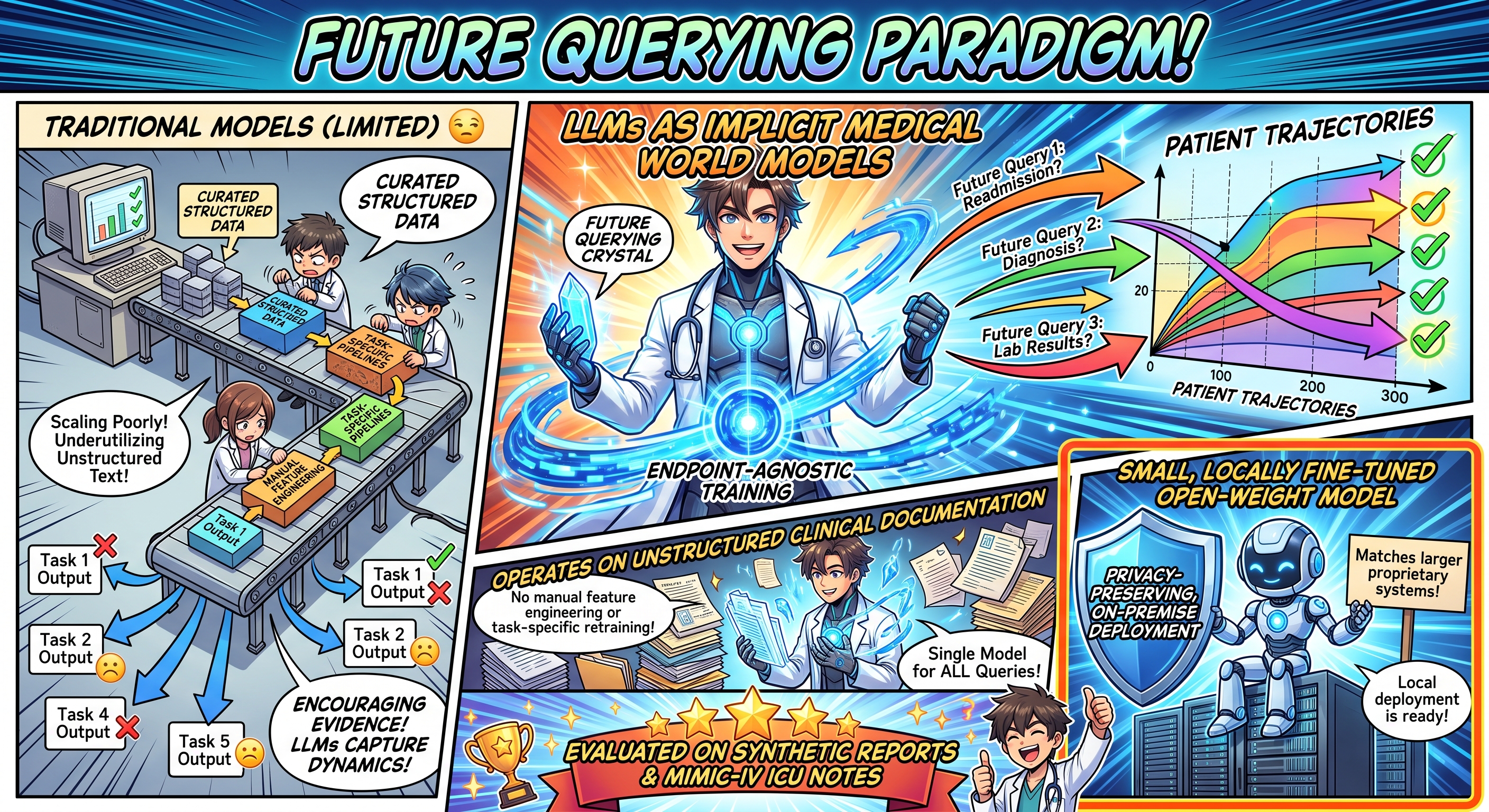
- Abstract: We present KernelArc, a multi-agent framework for autonomous GPU kernel optimization across heterogeneous workloads. Strategy-specialized agents run in parallel and coordinate through conclusions-only shared memory, a deterministic benchmark guard, and read-only cross-agent state with plateau-triggered drafting. We evaluate KernelArc on NVIDIA H100 and B200 GPUs using category-representative SOL-ExecBench workloads. The resulting implementations span custom BF16 GEMM, static cuBLASLt Expert-API configuration tables, fused mixture-of-experts backward, shape-gated decoder-layer fusion, native NVFP4 grouped-query attention, and paged prefill attention. In the public SOL-ExecBench leaderboard snapshot recorded on August 20, 2026, KernelArc ranked first on every representative L1, L2, Quantization, and FlashInfer task evaluated.
- Link: arXiv:2608.17071
- Image:
Future Querying: Can LLMs Serve as Implicit Medical World Models?
- Authors: Siri Willems, James Butterworth, Lore Goetschalckx, Peter Vrancx, Philippe Modard, Elke Giets, Ludovic Denoyer
- Release Date: August 24, 2026
- Where: Accepted at the World Model MICCAI 2026 workshop
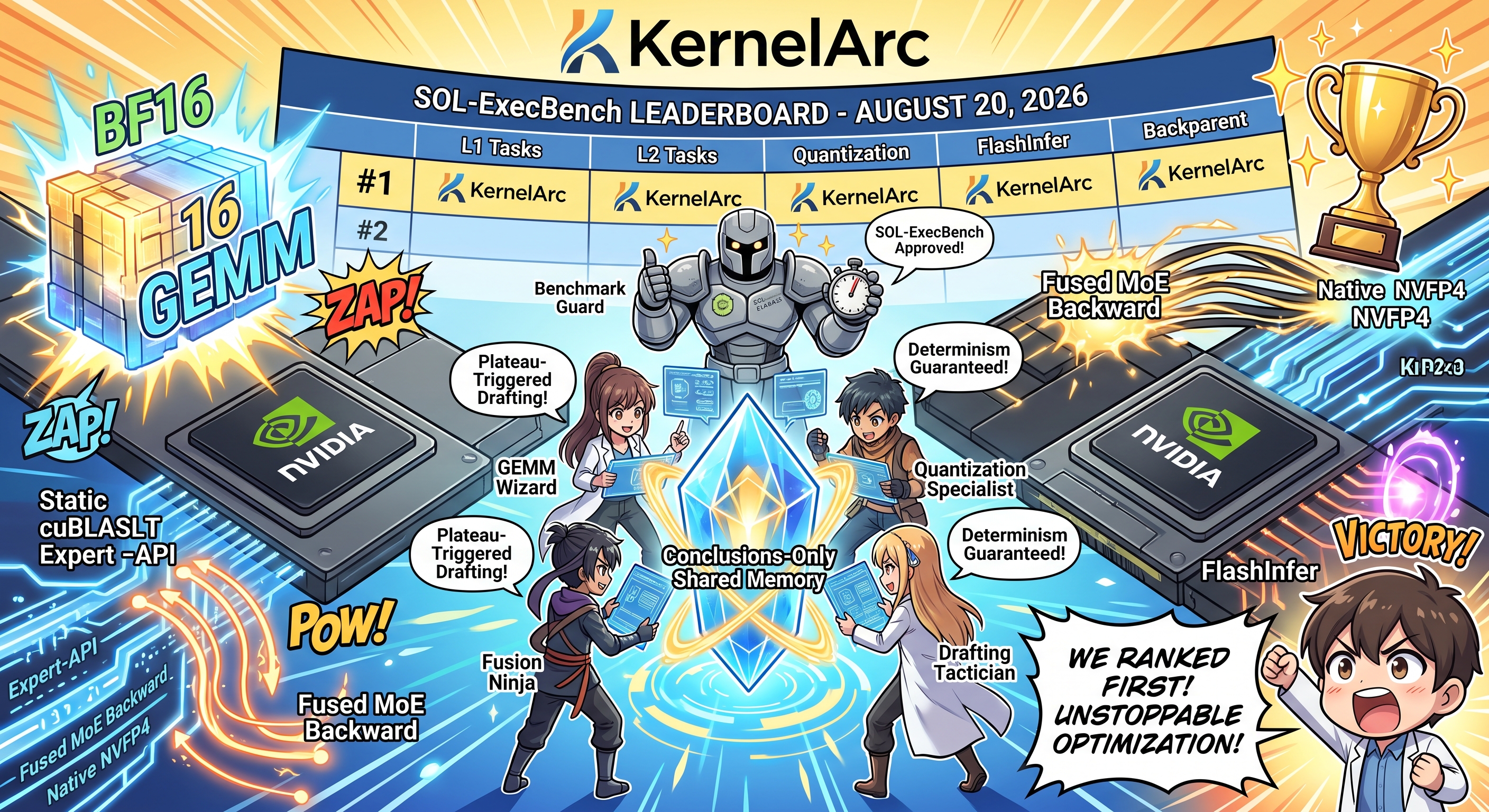
- Abstract: Traditional clinical prediction models rely on task-specific pipelines and curated, structured data, which scale poorly and underutilize unstructured text. To address this, we introduce future querying, a paradigm that probes whether large language models (LLMs) can function as implicit medical world models by evaluating their ability to answer time-indexed clinical queries about a patient’s future. Our framework operates on unstructured clinical documentation using endpoint-agnostic training, enabling a single model to answer diverse clinical queries over patient trajectories without manual feature engineering or task-specific retraining. We show that small, locally fine-tuned open-weight models can match or approach larger proprietary systems, making the framework suitable for privacy-preserving, on-premise deployment. Evaluated on a new synthetic medical reports dataset and real ICU notes from the MIMIC-IV dataset, our results provide encouraging evidence that LLMs can capture aspects of clinical dynamics.
- Link: arXiv:2608.23248
- Image: