
Agentic AI: toward a revolution in software engineering
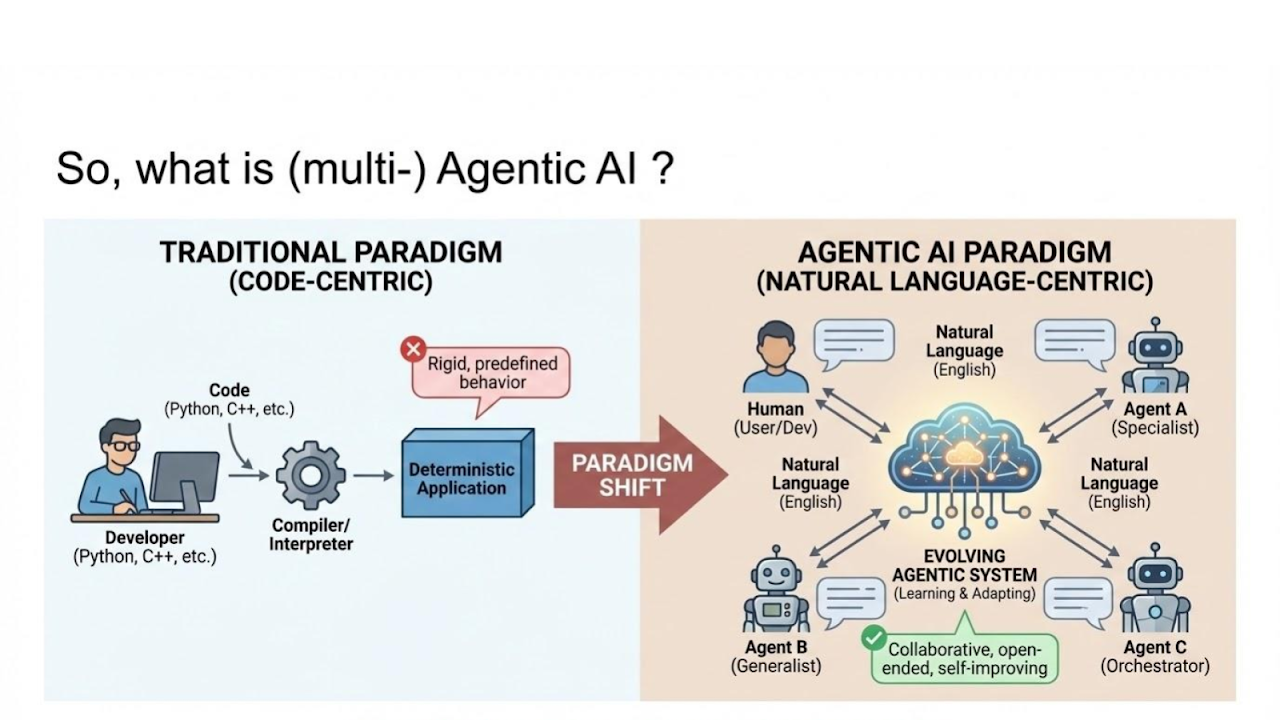
The landscape of software engineering is on the brink of a massive transformation. At imec, a world-leading research institute bridging deep scientific research with real-world impact, the Frontier AI Research Lab is exploring how reinforcement learning, multi-agent systems, and Agentic AI will radically redefine the future of technology. But what exactly is Agentic AI, and why is it being hailed as a new programming paradigm rather than just an incremental tech update? Let’s dive deep into the evolutionary steps of programming and see where we are headed.
The Rise and Limits of V/LLMs
Foundational multi-modal models—often referred to as Vision/Large Language Models (V/LLMs)—are incredibly powerful new technologies capable of processing text, images, and sound. Driven by transformer architectures, enormous datasets from the web, and next-token prediction, these models have become highly accessible and are now common software engineering tools.
However, V/LLMs suffer from one primary limitation: they exist in a “closed world”. A standard V/LLM makes inferences based purely on its own compressed weights, meaning its problem-solving ability is restricted to what was in its training dataset. It cannot access the latest news, tap into external knowledge bases, or interact efficiently with users in real-time.
The Current View: Just an Incremental Update?
To solve this “closed world” problem, developers introduced the concept of agents. In the current view, an agent is simply an LLM equipped with tools—giving it agency to call a search engine, act on programs, or interface with the outside world. Yet, many still view Agentic AI as a mere incremental update to existing technologies. It is often treated like putting a “smart” sticker on an old machine, focusing on optimizing current paradigms rather than questioning the entire foundation of software engineering.
The Drawbacks of Classical Software Engineering
To understand why a radical shift is needed, we must look at what software engineering actually is: a data transformation process where human intent (code) is compiled or interpreted into computer behavior.
Historically, humans have developed complex systems to solve identified needs through deterministic behaviors, manual coding, and rigorous testing. But the truth is, programming is inherently difficult—getting the details right at scale is hard. To manage the complexity, we created convoluted tools like Object-Oriented Programming, varied programming languages, complex databases (SQL, NoSQL), and rigid protocols.
Because human programmers are highly specialized and expensive, the resulting software is often flawed. We end up with “stupid” and predictable video game bots, incredibly complex and expensive User Interfaces (UIs), and horribly complicated, error-prone database schemas.
The Three Paradigm Shifts Toward Agentic AI
The path out of this deterministic, human-coded trap has occurred across three major paradigm shifts.
First Paradigm Shift: Machine Learning Machine learning introduced “learning-based programming,” where instead of explicitly writing rules, we provide raw data and examples. The system then “compiles” this data through a training process—like training a neural network on labeled images of cats and dogs—to output a desired behavior. This evolved further with Reinforcement Learning (RL), which allowed models to improve themselves by generating their own data and optimizing based on reward systems. However, adoption was difficult because it required a massive mindset shift from deterministic to stochastic models, and the traditional programming ecosystem was not mature enough to handle it.
Second Paradigm Shift: LLMs as Open-Ended Models Previously, machine learning required separate datasets and exhaustive training for each specific task (e.g., one model for translation, another for summarization). V/LLMs changed this by introducing Open-Ended Models. Now, a single model controlled by natural language prompts can quickly implement varied programs. In this new reality, English has become a new programming language.
Third Paradigm Shift: Natural Language Manipulation This is arguably the most underestimated shift: natural language is now in the loop, seamlessly connecting human intent with executable code. Historically, because computers couldn’t understand English, we built rigid structures (SQL, OOP) and physical shortcuts like the computer mouse to interact with machines.
Take a flight booking system, for example. In the old, absurd model, a user’s natural language request over the phone had to be translated by a costly human operator into a complex UI, which then manipulated an extremely costly database. Simply automating the operator with an AI agent is a step forward, but it still leaves the expensive, complex backend database and UI intact. The true promise of LLMs is to replace the complete stack: an LLM can directly process the unstructured English intent and translate it directly into a completed booking action, eliminating intermediaries entirely.
What (Multi-)Agentic AI Really Is
Agentic AI is not just about shoehorning LLMs into traditional software. Agentic AI is an entirely new programming paradigm where all information is represented and shared through natural language.
In this new paradigm: * English is the main human programming language. * Software components (specialist agents, generalist agents, orchestrators) share information with each other in natural language. * Software becomes an open-ended mix of humans and agents communicating without constraints, where a human can swap in for an agent at any time. * Systems naturally become better over time by leveraging generated data and machine learning.
We can see this shift happening across industries. In the automotive sector, complex and centralized CPU architectures processing distinct sensor data are shifting toward decentralized, agent-based architectures where a “Lidar Agent” and a “Camera Agent” simply communicate their findings in English to a central LLM brain. In healthcare, expensive, siloed patient databases are being replaced by Multi-Agentic AI, where human doctors and AI doctor agents seamlessly collaborate, share lab results, and discuss diagnoses in transparent natural language.
What We Need to Make This Happen
To fully realize this revolution, we must rethink software from scratch and reinvent the complete stack. This requires: * New programming languages designed to manipulate natural information and create agents. * Replacing old-school components with dedicated or generalist agents. * Efficient open-ended models and machine learning algorithms to drive these distributed systems. * New hardware, including chips and sensors, designed to natively handle conversational outputs. * New software engineering practices, such as replacing traditional unit tests with AI benchmarks.
Conclusion: Agentic AI for What?
Ultimately, while Agentic AI is completely changing how we conceive hardware and software, the real revolution lies in its usage. As we transition from developers focused on syntax and boilerplate to teams that guide AI with natural language, the priority must be leveraging this technology to build usages and investments that result in a genuinely better life. The Agentic AI era is here, and it speaks our language.